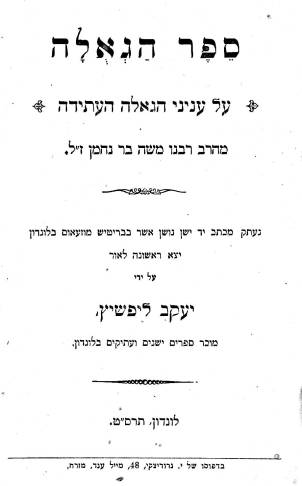
 This edition of Sefer HaGeula was copied (or edited) from an old manuscript in the British Museum (now in the British Library, if it has not been sold or stolen!).
The title means ‘The Book of Redemption’ and it is about issues of the future redemption. The publisher and editor was Jacob Lipschitz, a prominent London antiquarian Hebrew book-dealer. It was printed in 1909 and is number 66 in Moshe Sanders bibliography of books printed by Israel Narodiczky in Whitechapel.
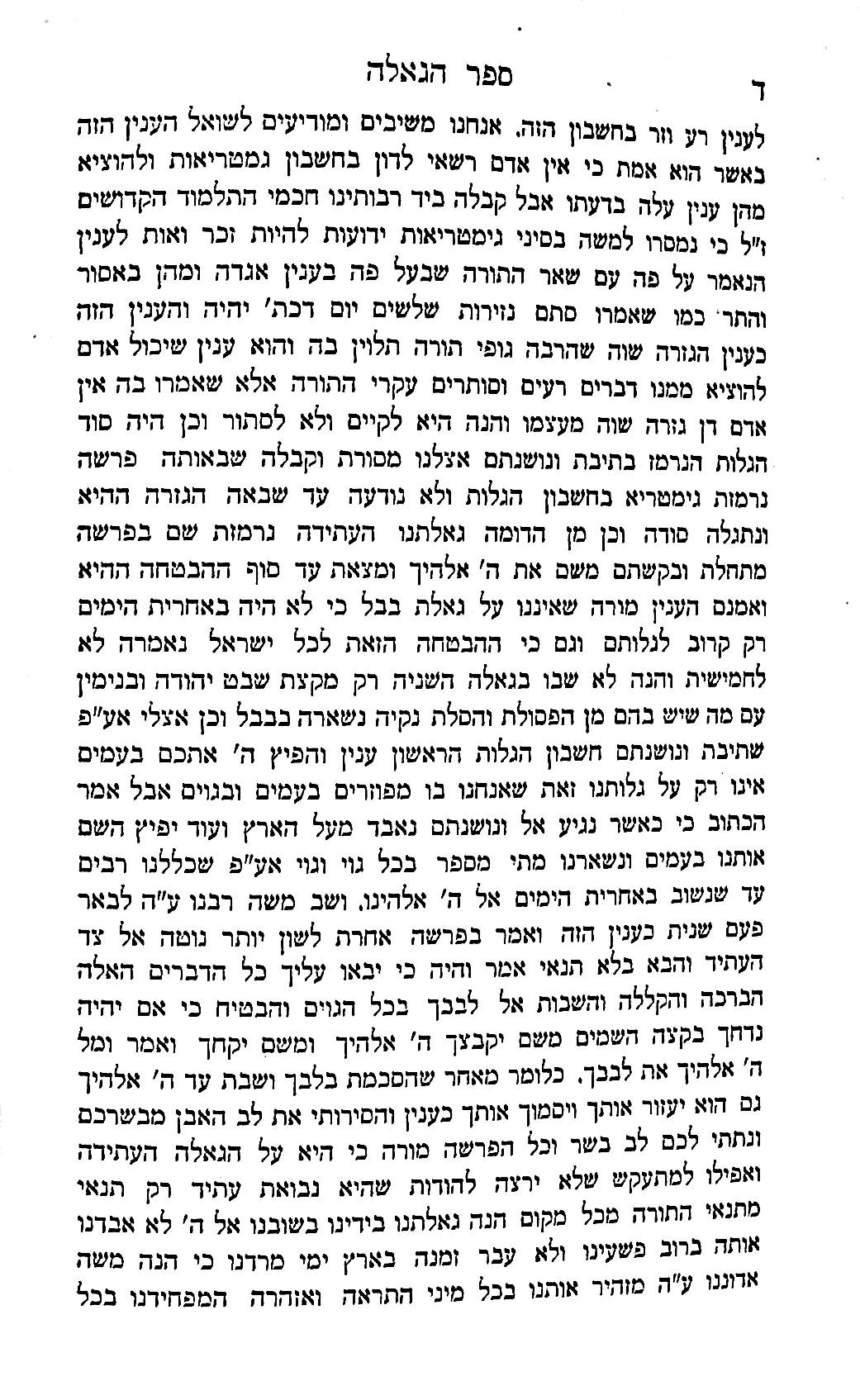
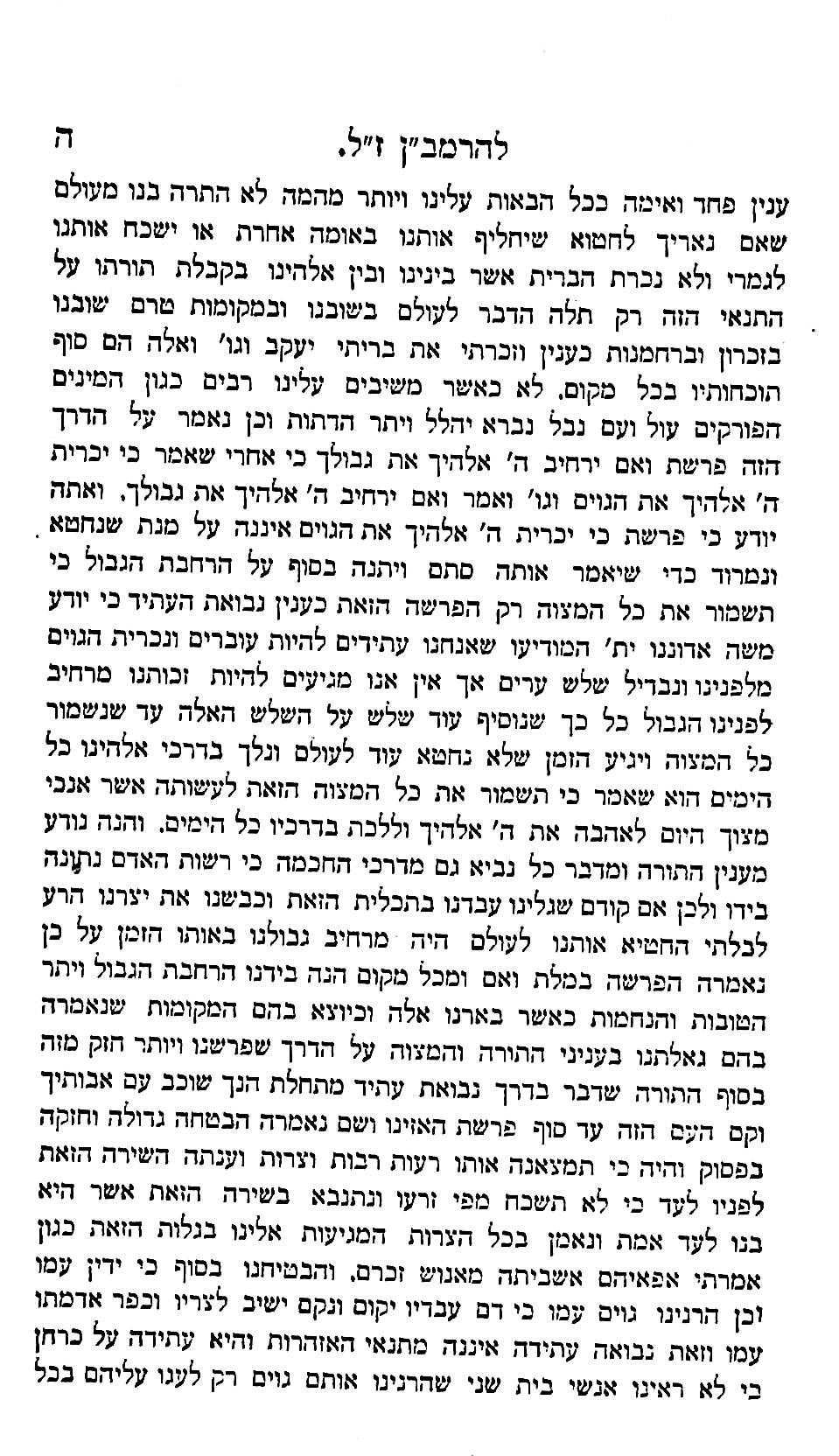
The Ramban writes about the going out of Egypt being the first redemption, and the return of the exiles from Babylon under the prophet Ezra as being the second redemption. He writes:
“Behold I will recall a matter that is expressly mentioned many times in Scripture. It is known that with the Return of the Exiles under Ezra only the Tribes of Judah and Benjamin returned. These had been exiled to Babylon by Nebuchadnezzar. This is what it says concerning the beginning of that Redemption, [Ezra 1:5] Then rose up the chief of the fathers of Judah and Benjamin, and the priests, and the Levites, with all them whose spirit God had raised, to go up to build the house of the Lord which is in Jerusalem.”
 The editor and publisher, Jacob Lipshitz was well-known and merited long obituaries in the Jewish Chronicle of July 3rd, 1914:
LIPSCHITZ.—Mr.. Jacob Lipschitz died on Wednesday week, at 170,  Amhurst Road, Hackney, at the age of sixty-two. He was one of the best-known antiquarian Hebrew booksellers in the country, and his clientele included the late Chief Rabbi, the Haham, Mr. Elkan N. Adler, and the Trustees of the British Museum and the Bodleian Library. In the East End he was better known for his large-heartedness and generosity. The burial took place on Thursday at Edmonton. Among those present were the Haham (who also sent to Mr. S. Lipschitz. a tribute to his father’s character and his services to Jewish science), Dayan Chaikin (on behalf of the Beth Din), the Rev. J. K. Goldbloom, Mr. W. Rabbinowicz (representing the National Fund Commission for England), Mr. A. Marks (for the East London National Fund Commission), Mr. E. N. Adler and Mr. I. Solomons.
A TRIBUTE BY MR. ELKAN ADLER.
It is with real grief that I have learnt of the death of Mr. Jacob Lipschitz, who was my bookseller and friend for twenty years. He was a remarkable type of man, unassuming yet independent, and fairly entitled to take high rank in the number of mochre sefarim like Rabinowitz, Fischel Hirsch, Schonblum, and Deinard. Always quiet and unassuming, he developed a remarkable flair in recognising a treasure or a curiosity. He started in quite a small way. and the books he originally offered were not of peculiar interest. But almost suddenly he seems to have taken to travelling, especially in the East, and many of the postcards he sent when on the road contained quite exciting news of his trouvailles.
No hardship was too great and no time too long if it resulted in bis getting the books we sought. His method of procedure was like that of the magician in the Arabian Nights, who was prepared to exchange old lamps for new. He had supplied many a Yeshiba with the best modern editions instead of the old and often dilapidated tomes which were despised by the Wise Men of the East.
Though never a talker, he could have told an interesting story of his travels and adventures. Only last year, he was in a railway accident, in which many travellers lost their, lives, and there can be no doubt that the hardships he endured hastened his end. He was probably the only bookseller who landed and stayed in the Island of Jerba which is protected by the shallow water that surrounds it, and where he found unique incunables brought there by Jewish refugees from Spain. Three years ago he rode to Fez, meeting Professor Westermark on the way, and discovered that a Printing Press had been established there in the first quarter of the 16th century by Portuguese exiles who for a very few years were engaged inproducing ‘what were certainly the first books primed hi Africa. No doubt he was assisted in his travels by his British Passport; and thereby hangs a story. He applied for a Certificate of Naturalisation many years ago but it was refused on the ground that he could not write English with sufficient facility. I applied to Mr. Herbert Samuel, who was then the Under Secretary of State for Home Affairs, and he was good enough to get Lord (then Mr.) Gladstone, his Chief, to reconsider his decision. The step was a wise one and fully justified by the results, which have been to enrich the collections of the national libraries like the British Museum and the Bodleian, as well as those of private collectors.
Mr. Lipschitz never haggled about prices. His prices were not high, but once he fixed a price he stuck to it. When he came, to me, bringing books, he was never allowed to go away, and, while waiting for me during absence used to spend the interval in opening his parcel and reading the Hebrew newspaper in which the books were wrapped.
He was an affectionate husband and an indulgent father, and perhaps his greatest grief was that his son had not his affection for books.
Mr. Lipschitz gave liberally—more than his means allowed—yet always with such unobtrusiveness as betrayed the real fineness of his character.” He gave secretly, “and blushed*to find it known.” The door of his house was ever open to the poor and the stranger. Many a poverty-stricken Jew will miss his kindly figure. He also possessed a keen sense of humour—the saying grace of the Jew—made all the more effective by a delightful dryness of manner. He had been a “Maggid” in his earlier years in Russia, and his wide knowledge of Midrashic literature was often seen in his conversation, where his homiletical mind gave a real distinction and flavour to many of his remarks. Coming from the dusty thoroughfares of London into the peace and calm of his bookshop was like entering a charmed house where everything is redolent of old-world fashions and kindness and chivalry, Mr. Jacob Lipschitz travelled very extensively in Europe, Asia Minor, and North Africa, and many were the exciting narratives he could tell of some precious incunabula unearthed from the dust heaps and Genizahs of synagogues. ……. J. LEVEEN.



 Jewish Miscellanies