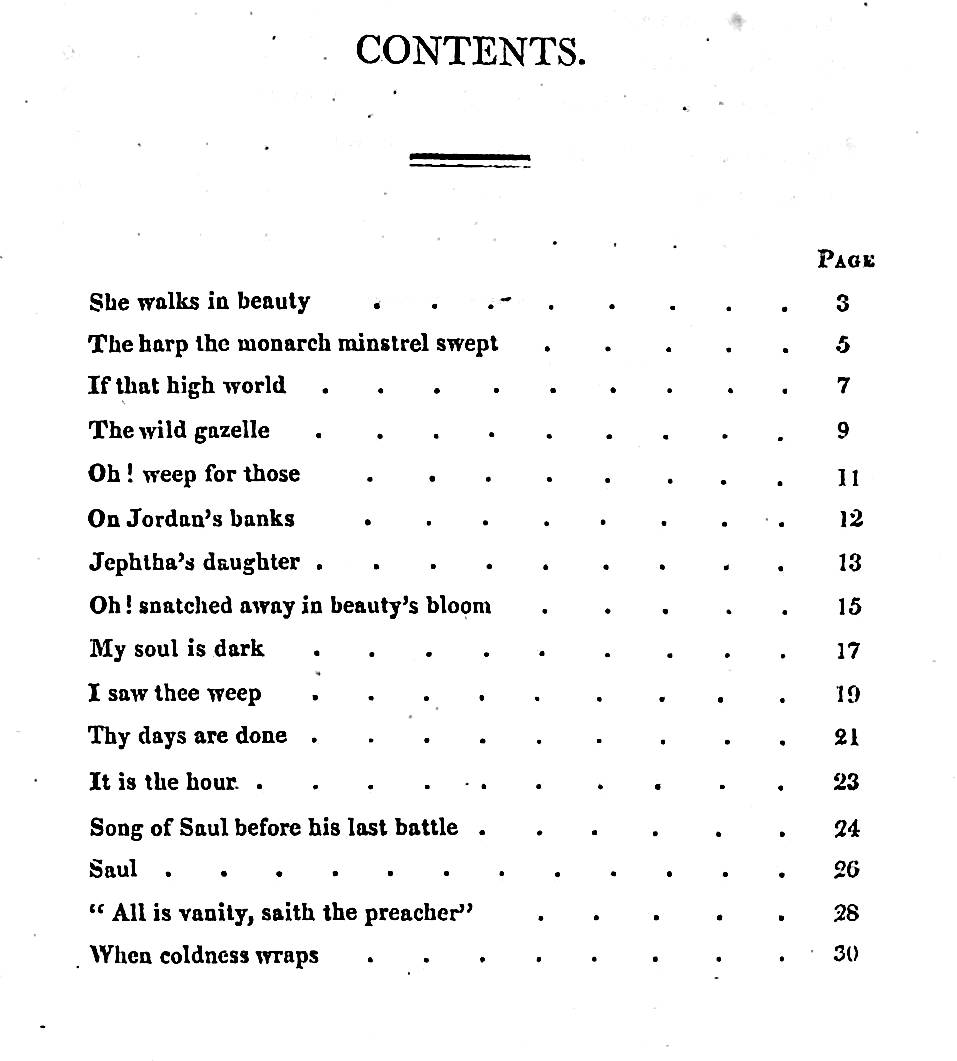
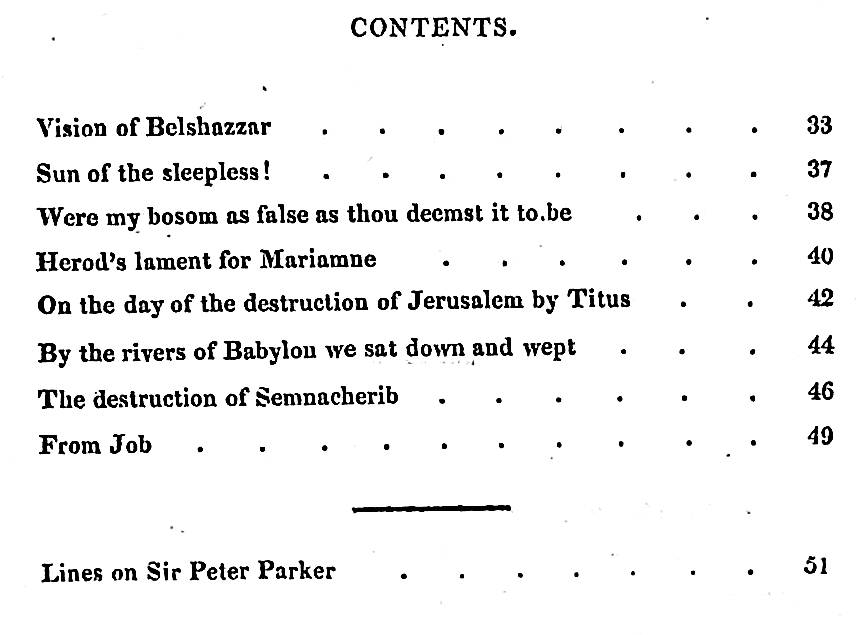
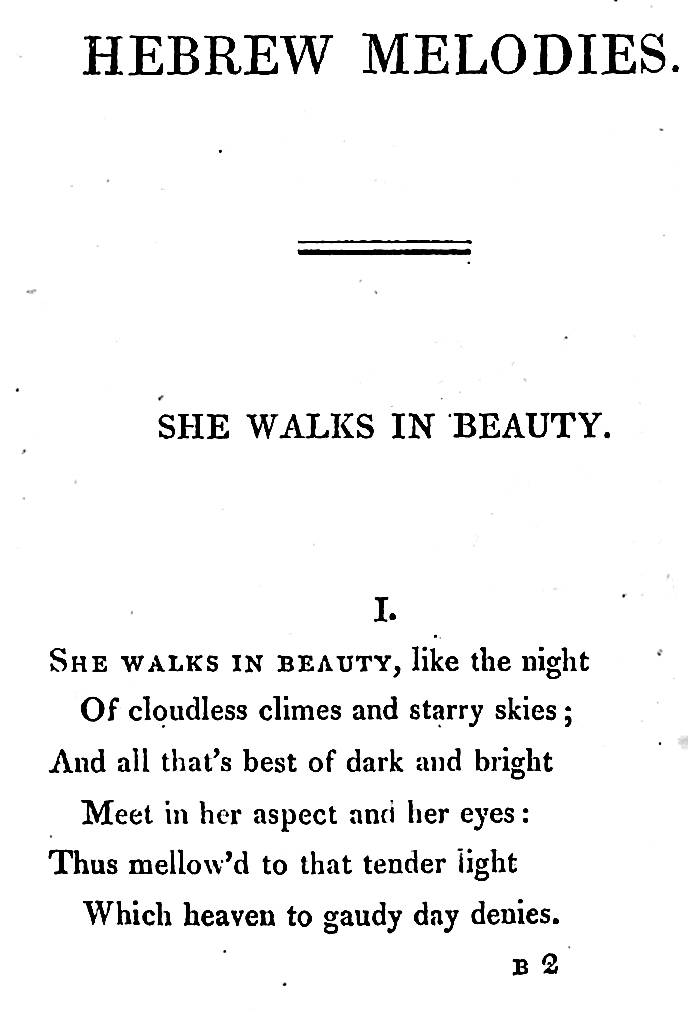
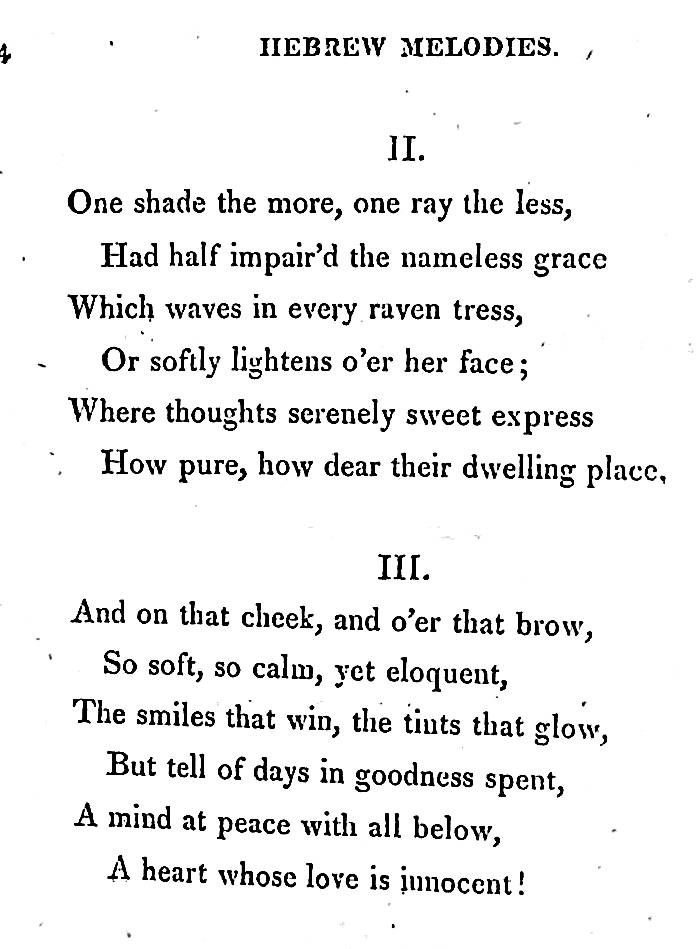
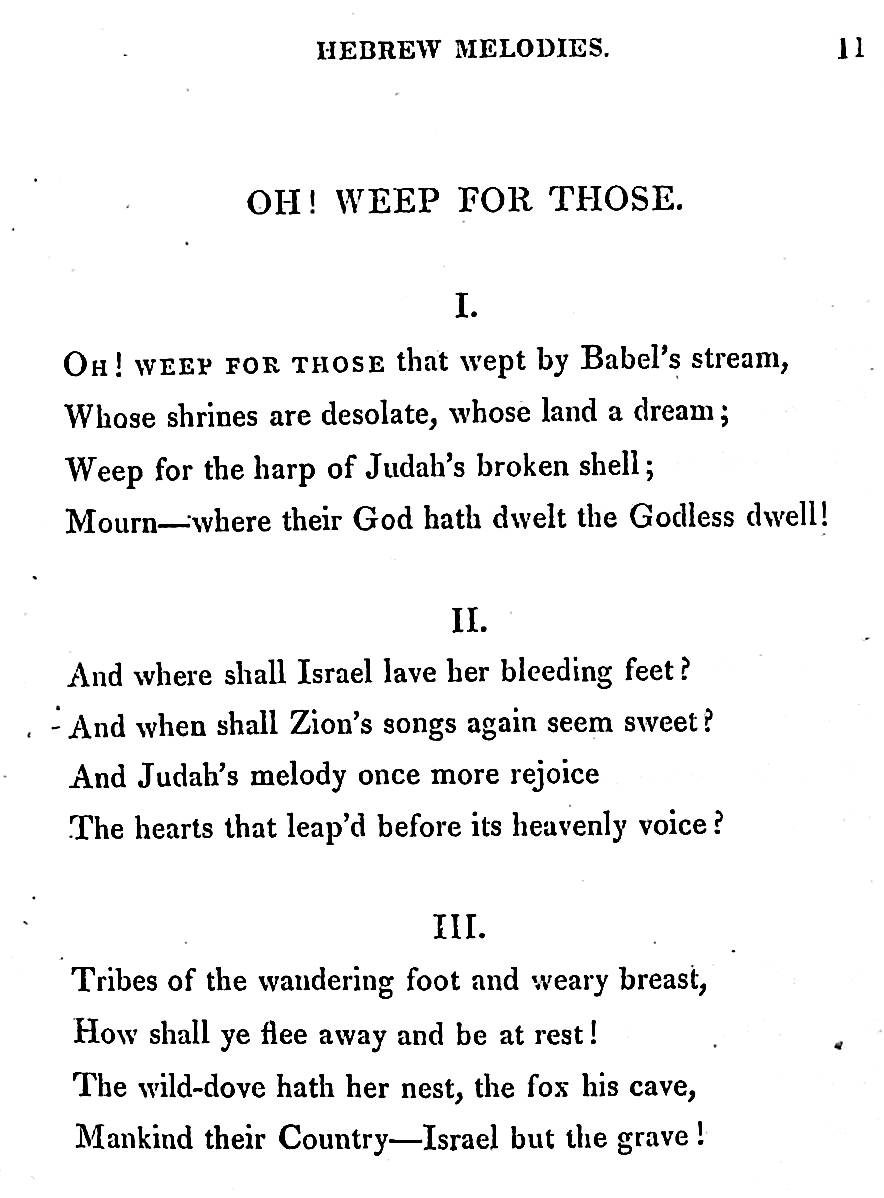
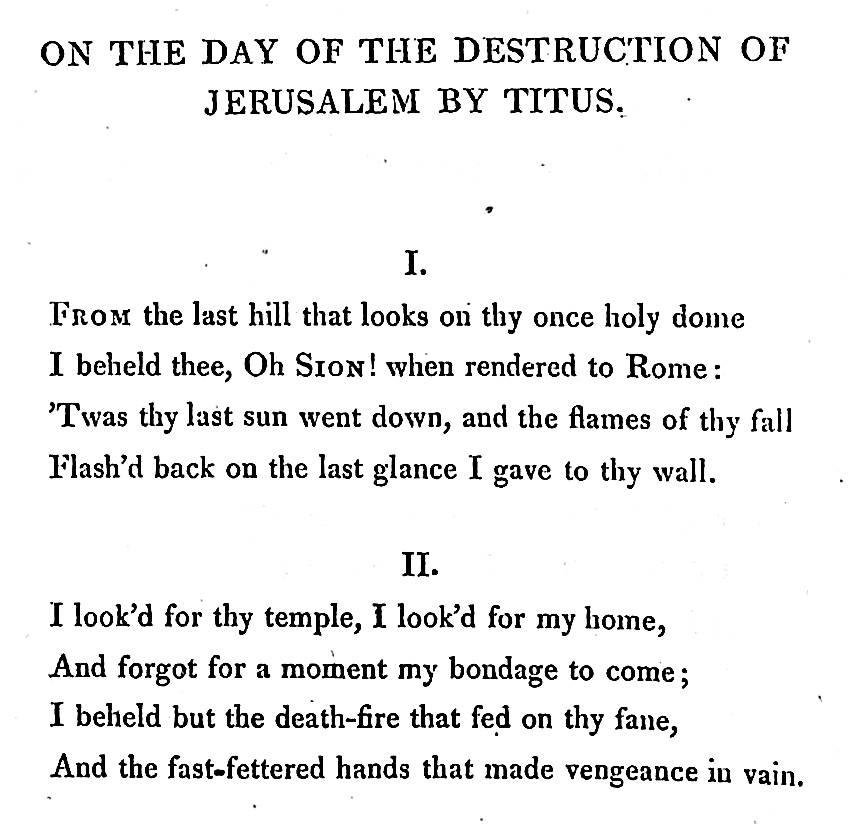
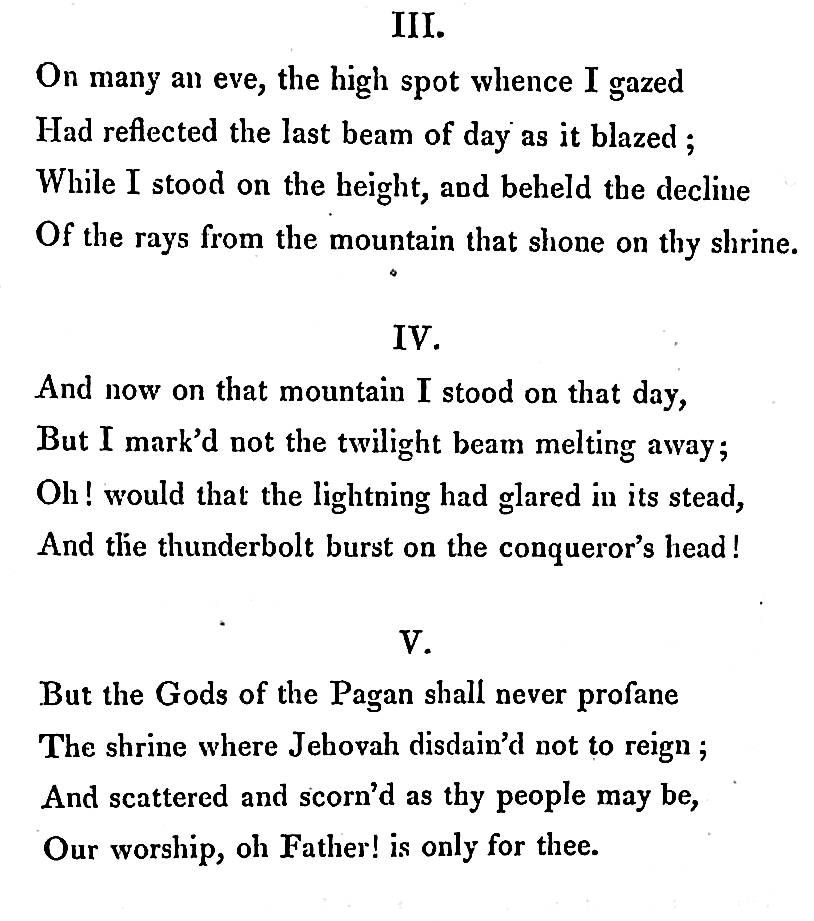
 Hebrew Melodies, which is a collection of poems by Lord Byron, were mostly written to accompany music of the composer, Isaac Nathan. My copy is the first edition, first issue, printed by T. Davidson of Lombard Street, for the publisher, John Murray.
Isaac Nathan was an aspiring composer who was born in 1790 to parents who had immigrated from Poland. His father was the Chazan (cantor) of Canterbury synagogue, and Isaac was originally educated to be a rabbi. He had published an advertisement in the London Gentleman’s Magazine in May 1813 that he was “about to publish ‘Hebrew Melodies’, all of them upward of 1000 years old and some of them performed by the Ancient Hebrews before the destruction of the Temple”. At this stage, he had no words to go with the melodies which he intended to adapt from synagogue usage (although many of the tunes did not have the ancient ancestry that he claimed). Byron was encouraged by his friend Douglas Kinnaird to take up Nathan’s proposal. Many of the poems were written during the period of Byron’s sessions with Nathan between October 1814 and February 1815; a few, including the first one “She Walks in Beauty” predate their meeting, although Nathan set this poem to a melody that was used in the Synagogue for Adon Olam, a song that is sung in the Synagogue at the end of the Saturday morning service.
Byron seems to have been sympathetic at the time to the cause of the Jews, and left the copyright of Hebrew Melodies to Nathan.
The first volume of twelve musical settings by Nathan for voice and piano was published in April 1815 by Nathan himself. In May of the same year this book containing Byron’s complete lyrics Byron’s complete lyrics was published.
Just before Byron left England, Nathan sent him some motzas, with the following note:
My Lord, I cannot deny myself the pleasure of sending your Lordship some holy biscuits, commonly called unleavened bread, and denominated by the Nazarites Motsas, better known in this enlightened age by the epithet Passover cakes; and as a certain angel by his presence, ensured the safety of a whole nation, may the same guardian spirit pass with your Lordship to that land where the fates may have decreed you to sojourn for a while.
Byron acknowledged the gift:
Piccadilly Terrace, Tuesday Evening
My dear Nathan, – I have to acknowledge the receipt of your very seasonable bequest, which I duly appreciate; the unleavened bread shall certainly accompany me on my pilgrimage; and, with a full reliance on their efficacy, the Motsas shall be to me a charm against the destroying Angel wherever I may sojourn; his serene highness, however will, I hope, be polite enough to keep at desirable distance from my person, without the necessity of besmearing my door posts or upper lintels with the blood of any animal. With many thanks for your kind attention, believe me, my dear Nathan,
Yours very truly,
BYRON
Isaac Nathan emigrated to Australia in 1841, On 15 January 1864 he was run over and killed by a horse-drawn tram in Sydney, at the intersection of Pitt Street, where he lived at No. 442, and Goulburn Street.




 Jewish Miscellanies
Quite extraordinary!!
What a story-Byron and Nathan the author in 1815 -as Europe was crashing around the Napoleonic wars.
Their correspondence is very touching, charming and nuanced.
Did Nathan (or anybody else!) subsequently ever produce or perform these items?
Although the famous Anglo-Jewish tenor John Braham leant his name to the publication of the poems with Nathans music, there is no record of his ever performing them.