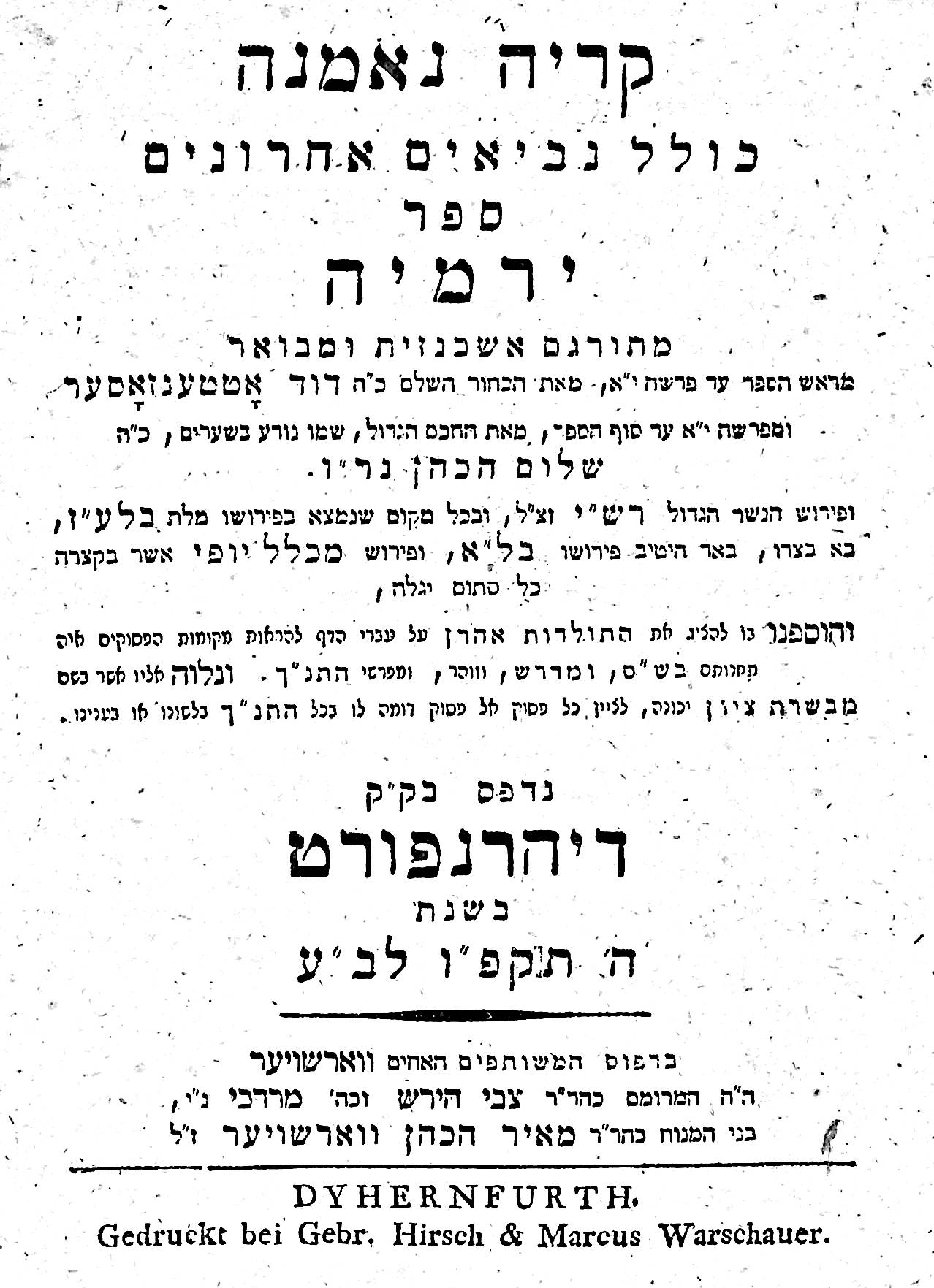
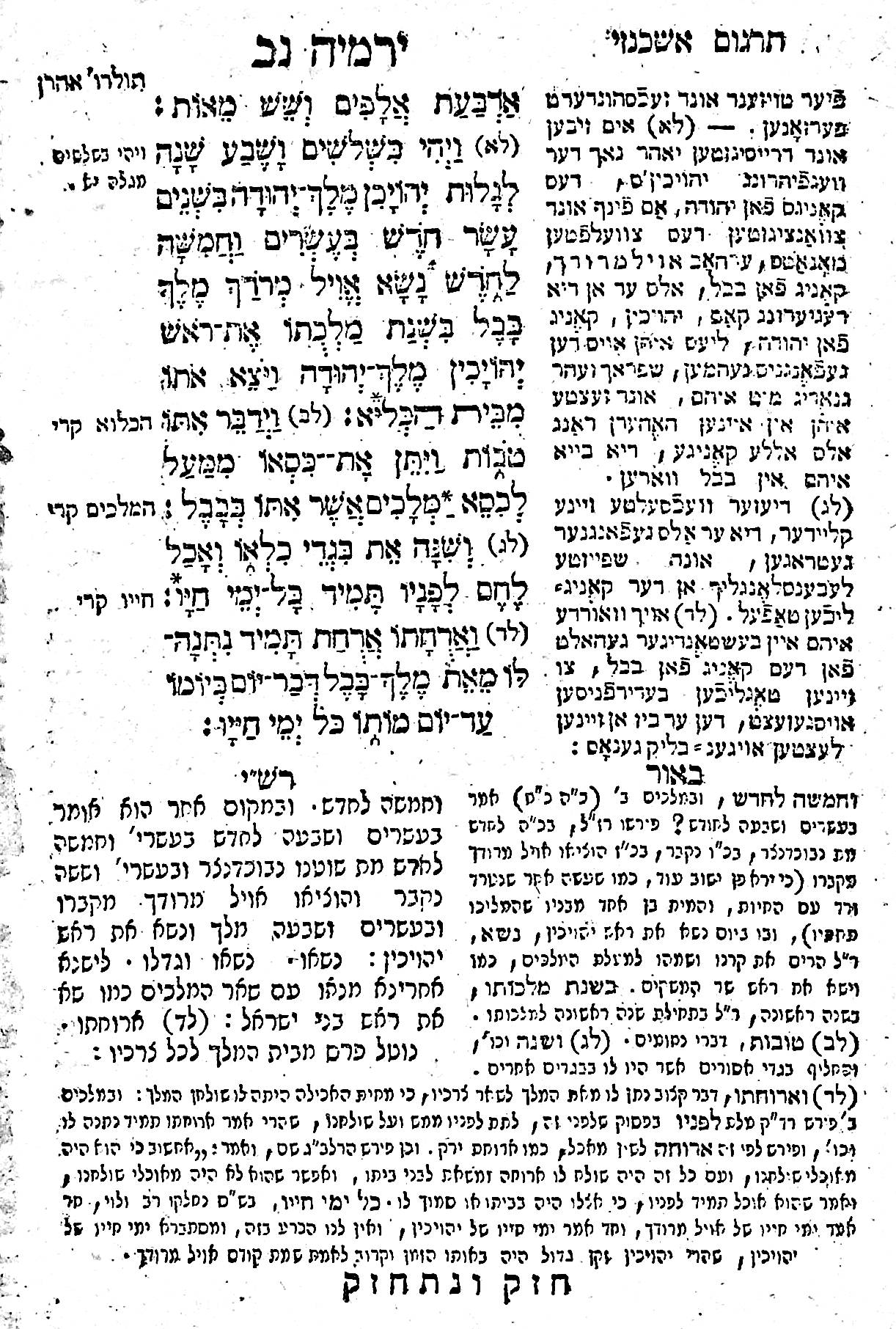
 This edition of Kiriyah Ne’emana (the prophets and scriptures) was printed in Dyhrenfurth in 1825. Dyhrenfurth (in Polish Brzeg Dolny) is a town in lower Silesia, whose Jewish community was established with the first Hebrew printing house there in 1688 and declined with the closure of the printing houses there in the late nineteenth century. It was known for fine and popular editions.
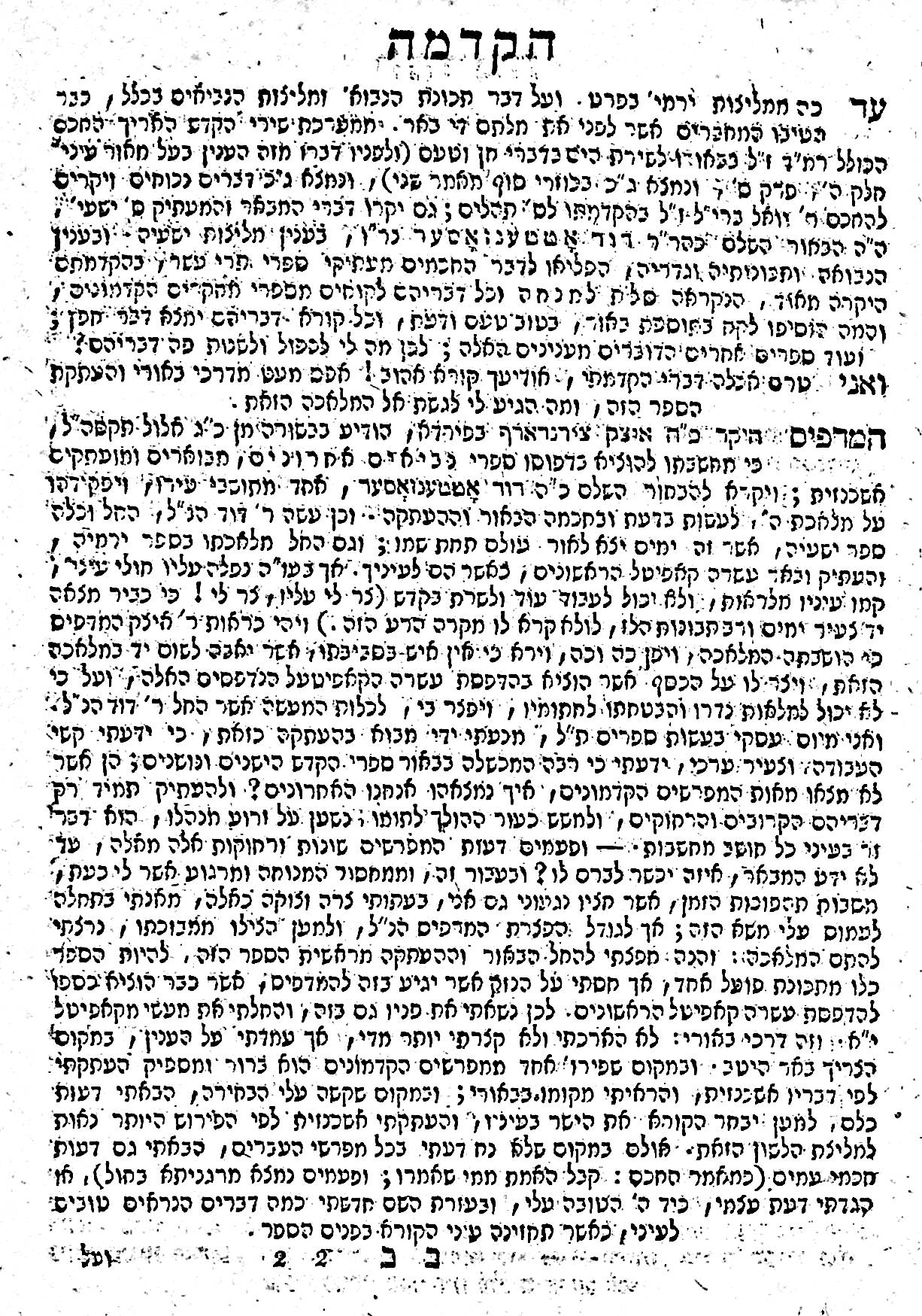
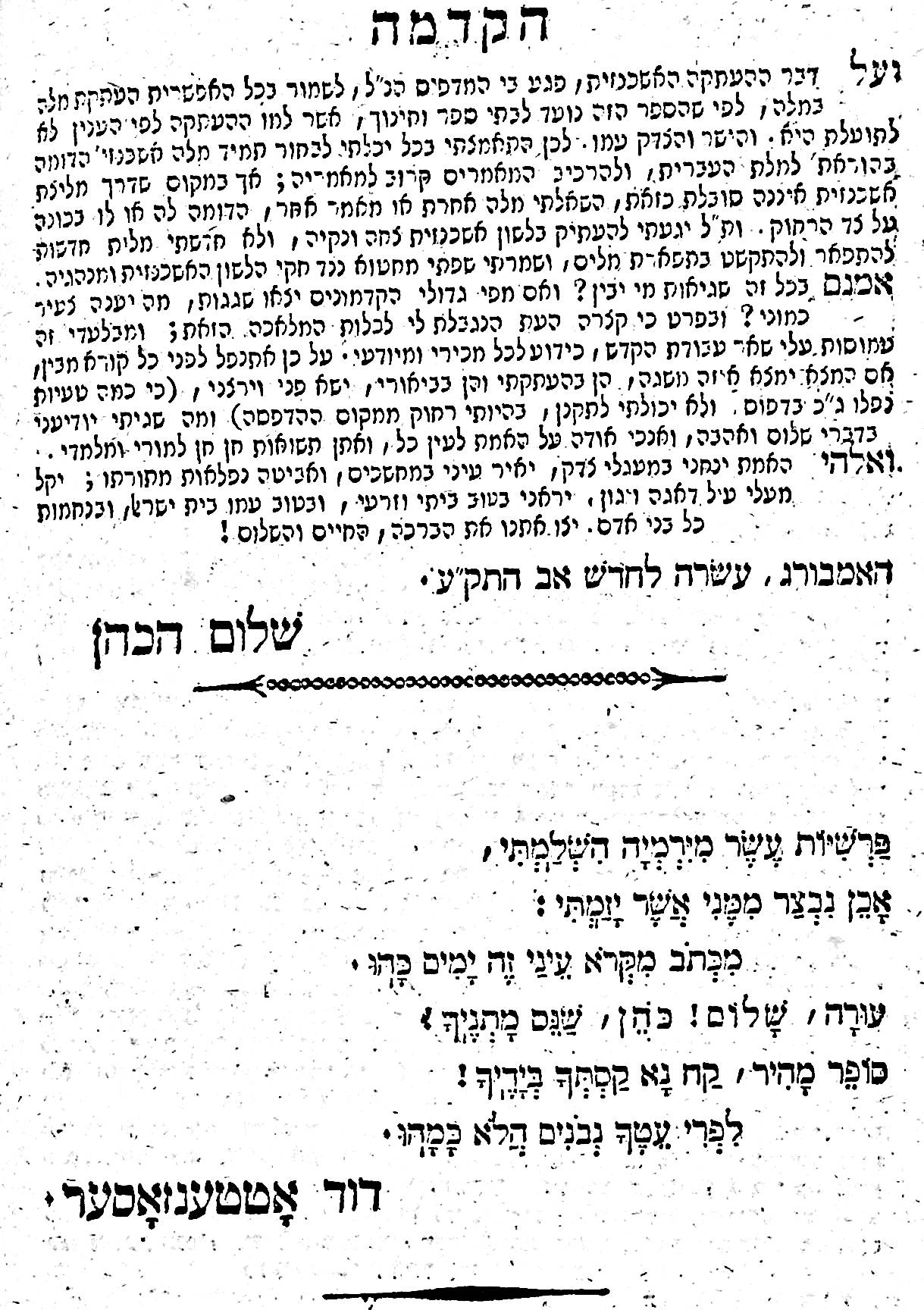
This edition, as well as Rashi, includes a translation into German (in Hebrew letters) and a commentary by David Ottensoser. He was a learned translator and commentator, described by the London Jewish Chronicle in 1849 as “one of the greatest exegetics of our age” and “the veteran commentator of the German school”. However, after translating the first 11 chapters of Jeremiah, he was unable to continue as he had become blind.
The rest of the translation and commentary was done by Rabbi Shalom Cohen. Shalom ben Jacob Cohen (1772–1845) was a Hebrew writer, poet and scholar. He was born in Mezirich in Poland. Cohen went to Berlin in 1789 and served as a teacher as well as the editor of Ha-Me’assef (in the years 1809–11), a periodical which aimed to spread the use of the Hebrew language among educated Jewish youth. In 1813 Cohen left Germany, spent a short period in Amsterdam, and moved to London where he tried unsuccessfully to establish a Jewish school and published a text book for Jewish youth, Shorshei Emunah in 1815 – a book that I have and have written about previously.
He moved to Hamburg circa 1816-1817. In 1820 he was invited by Anton Schmid to serve as head proofreader in the Hebrew section of his printing press in Vienna, where he remained for 16 years. In 1821 Cohen established the annual Bikkurei ha-Ittim, three issues of which appeared under his editorship. In 1836 Cohen returned to Hamburg, where he remained until his death.
 My copy belonged to Rabbi Tzvi Hirsch Ferber. He was born in Slobodka, a suburb of Kovno, Lithuania, in 1879. Rabbi Ferber was a renowned Torah and Talmudic scholar who emigrated to Manchester, England in 1911 and then in 1913 became the Rabbi and leader of the West End Talmud Torah Synagogue (Kehilas Yeshurun) in Soho, London.
Rabbi Ferber was active in the affairs of the London orthodox Jewish community. He established the Chesed V’emeth Burial Society in 1915. He was for many years the honorary secretary of the London “Vaad Harabonim” (rabbinical council) and chairman of the Association of London Rabbis (“Hisachdus Harabonim”).
He ministered to the needs of his synagogue, which included many small tradesmen, artisans and shopkeepers in the West End of London, by some accounts not the most educated or sophisticated congregation. However, this left him free time to be a scholar and spend much time in the nearby British Museum reading room, where he was a regular.
Much has been written about him, including his memoirs of his early life edited by Rabbi Pini Dunner.



 Jewish Miscellanies